AI Chatbot for Hotels: Answer Every Guest Message, Day and Night, and Win More Direct Bookings
An AI chatbot for hotels answers guest questions and booking enquiries on your website, WhatsApp and social media, 24 hours a day, and hands the conversation to your staff when a person is needed. It is best for small and mid-sized hotels, guesthouses and resorts that do not have someone on the front desk to answer messages at 11 p.m.
The idea is simple. Guests ask the same questions again and again: is breakfast included, is there parking, can I check in early, how far is the airport. A chatbot trained on your own information answers these in seconds, collects the details of a booking enquiry, and passes it to your team. Your staff spend less time typing the same replies and more time with the guests in front of them.
In this guide we explain what a hotel chatbot can and cannot do, what the rules say about guest data, what it costs, and where it goes wrong. If you run a hotel and want one set up for you, you can reach us at AutomateRoyal or by email at automateroyal@gmail.com.
Why Hotels Need a Chatbot
Guests now expect to message, not to phone. A survey by the hospitality software company eviivo, which asked 430 travellers worldwide in August and September 2025, found that 58% prefer text messages, WhatsApp or email links for quick exchanges with an accommodation provider. 25% would rather speak to a person, as long as the follow-up is prompt. A chatbot covers the first group and routes the second to your staff.
The messages also come in waves. Duve, another hotel software vendor, looked at thousands of guest interactions across its own client hotels and reported that WhatsApp carried 50.2% of all guest messages, that about a quarter of messages arrive on the day of check-in, and that over 36% of guests send two or more messages before or during their stay. Duve sells a messaging platform, and it does not publish the number of hotels or the period, so read these as a picture of its own customers, not as an industry average.
There is also a booking side. When a visitor asks a question on your website at night and nobody answers, they may book through an online travel agency instead, and the agency charges you a commission on that booking. Commission rates differ by agency and by contract, so check your own figures. A chatbot that answers quickly and hands the guest to your own booking page gives you a chance to keep that booking direct.
Sources: eviivo guest communication survey and Duve guest messaging data.
What a Hotel Chatbot Can Handle
A good chatbot does a short list of jobs well. It does not try to do everything.
- Answers common questions. Check-in and check-out times, breakfast, parking, Wi-Fi, pets, airport transfers, nearby places, and the hotel’s policies, all from the information you give it.
- Takes booking enquiries. It asks for dates, number of guests and room type, then sends the enquiry to your team or to your booking page. It does not promise availability or a price unless it is connected to your booking system.
- Sends pre-arrival messages. A welcome message, directions, and what to bring, a few days before arrival.
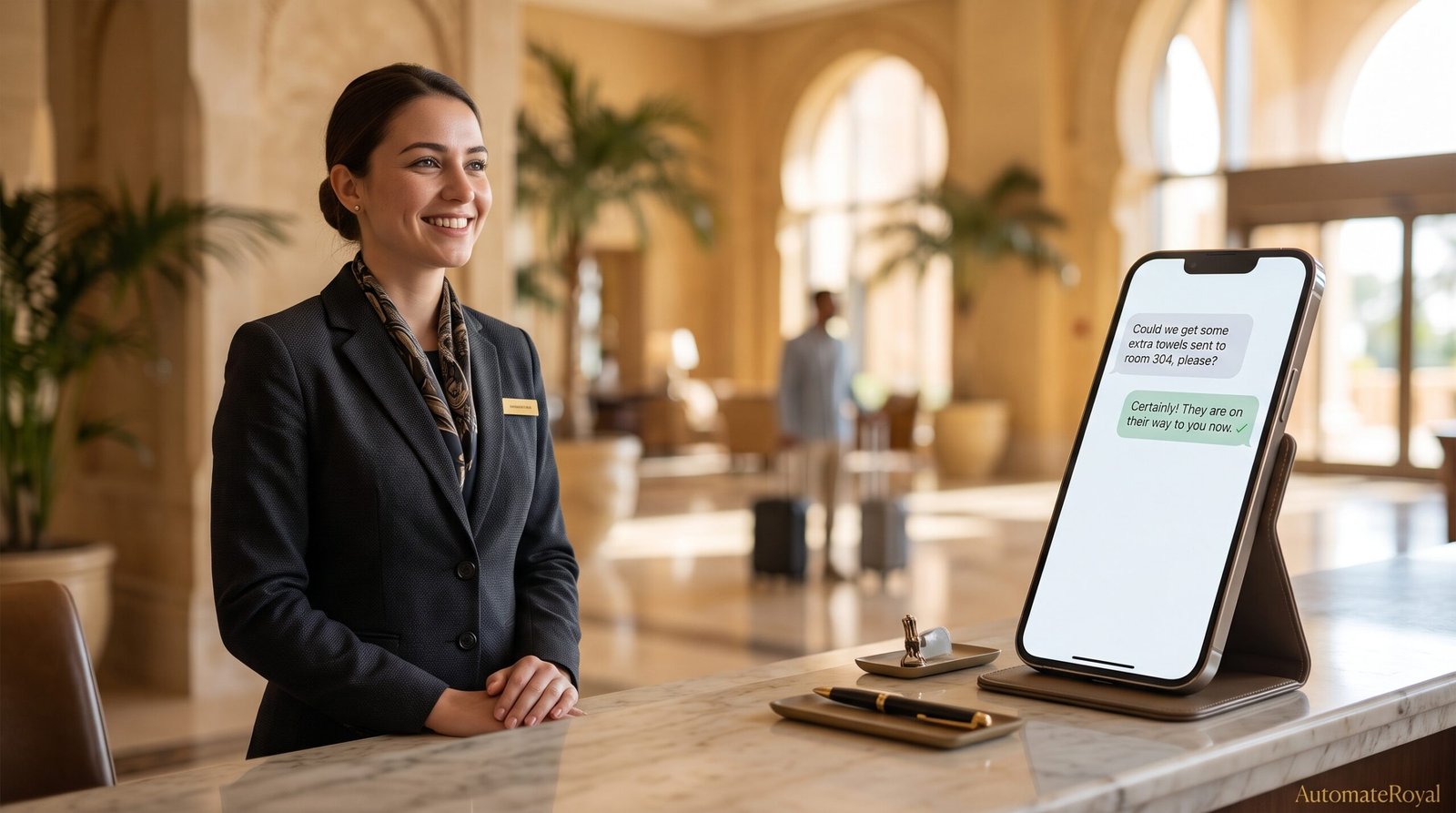
- Handles simple requests during the stay. Extra towels, late check-out requests, restaurant reservations, passed to the right person.
- Replies in the guest’s language. Many hotels in the Gulf and the UK serve guests who write in Arabic and English, and the chatbot can answer in both.
- Alerts staff. Anything it cannot answer, or any message that sounds like a complaint, goes straight to a person with the conversation attached.
The chatbot works from your own approved information, so it answers the way your hotel would, not from the internet at large.
Where the Chatbot Lives: Website, WhatsApp and Social Media
The same chatbot can sit in more than one place.
- Website chat. The easiest place to start. Visitors ask a question and the chatbot can point them to your booking page.
- WhatsApp. The most useful channel for hotels serving guests from the Gulf, the UK and many other countries. Guests message the hotel’s WhatsApp Business number and get an answer straight away. We cover this in our guide to WhatsApp AI assistants for businesses in Saudi Arabia and Qatar.
- Instagram and Facebook messages. Useful if your guests find you on social media.
- Missed call follow-up. If a call goes unanswered, an automatic text can invite the guest to continue by message. See our guide to missed call text back.
If you also receive many booking enquiries that need chasing, our guide to lead follow-up automation explains how to follow up politely without sending too many reminders.
The Rules: Guest Data, WhatsApp and Being Open About the Bot
A hotel chatbot handles names, phone numbers, travel dates and sometimes special requests, so data rules apply. Here are the main points. They are summaries, not legal advice, so please check with a lawyer in your country.
WhatsApp. In October 2025 Meta changed the WhatsApp Business Solution terms to bar companies from using it to distribute general-purpose AI assistants. The change took effect on 15 January 2026. TechCrunch reported that Meta said it does not affect businesses using AI for customer service, and gave the example of a travel company’s customer service bot. A hotel chatbot that answers questions about your own hotel is that second kind. Read the report on TechCrunch.
UK. UK GDPR asks you to tell guests what data you collect and why, to collect only what you need, and to keep it secure. Marketing messages need the right consent and an opt-out. Check the ICO’s current guidance, which is under review.
Saudi Arabia. The PDPL asks for consent for each purpose, an easy opt-out for marketing, and limits on sending personal data abroad.
Qatar and the UAE. Qatar’s Law 13 of 2016 asks for consent, and prior consent for direct electronic marketing. The UAE’s Federal Decree-Law 45 of 2021 asks for specific consent and restricts transfers abroad.
Our practice. We keep guest data in your own accounts, collect only what the answer needs, never ask for card numbers in chat, tell guests they are talking to an automated assistant, give an easy way to reach a person, and stop messaging anyone who opts out.
What Stays With Your Staff
A chatbot is the front door, not the whole hotel. Some things should always reach a person.
- Complaints. A guest who is unhappy wants a person who can act. The chatbot should apologise briefly, tell the guest that a manager will respond, and alert your team at once.
- Payments and card details. Guests should never be asked to type card numbers into a chat. Send them to your secure payment page or to the front desk.
- Special requests and allergies. A chatbot can pass the request on, but staff must confirm it.
- Anything unusual. If the question is not in the information you gave it, the chatbot should say so and hand over, not guess.
- A guest who asks for a person. Always give an easy way to reach one.
A simple rule we use: the chatbot answers what is written down, and everything else goes to your team with the conversation attached.
What a Hotel Chatbot Costs
The cost has two parts. First, a one-time setup, which depends on how much information the chatbot needs to learn, how many languages it speaks, which channels it uses, and whether it connects to your booking or property system. Second, small monthly running costs, mostly the message fees from WhatsApp and the AI and hosting costs behind it. A single small hotel on website chat and WhatsApp is the simple end. A group with several properties, several languages and a booking system connection is the larger end.
We do not quote prices in articles, because they change with the tools and the scope. For the factors that move the price, read our guide on what AI automation costs for a business. For a quote based on your own hotel, book a free 20-minute call.
Where Hotel Chatbots Go Wrong
A chatbot can help a lot, but a careless one can hurt your reputation. These are the common problems.
- Wrong answers. If the chatbot is given old or incomplete information, it will give old or incomplete answers. Someone must own the information and update it when prices, hours or policies change.
- Promising what you cannot deliver. A chatbot that confirms rooms or prices without being connected to real availability will cause disputes. We keep it to enquiries unless it is properly connected.
- Hiding that it is a bot. Guests should know they are talking to an automated assistant, and should be able to reach a person.
- No handover. A chatbot that keeps replying to an angry guest makes things worse. Handover rules must be tested.
- Too many messages. Promotional messages on WhatsApp to guests who did not ask for them can lead to complaints and blocked numbers.
- Not a replacement for hospitality. Guests choose a hotel for the welcome. The chatbot should free your staff for that, not remove it.
- Platform changes. WhatsApp, Google and the AI tools change their rules and prices from time to time, so the setup needs an occasional check.
How We Set This Up for You
- Free 20-minute call. We learn how your guests book and message, and which channels you use.
- Plan. We agree what the chatbot should answer, what it should hand over, which languages it speaks, and the rules for guest data.
- Build. We set it up in your own accounts, so you own it and can see everything it does.
- Test. We ask it the questions your guests ask, in each language, and check every answer and handover.
- Handover. We show your team how to update the information and read the conversations, and stay available if you need changes.
What you get: a chatbot trained on your hotel’s information, answers in the languages you choose, booking enquiries sent to your team, alerts for complaints and anything unusual, and a simple report of what guests ask.
Frequently Asked Questions
Will the chatbot replace my front desk? No. It answers the repeat questions and passes the rest to your team, so your staff can spend more time with guests.
Can it take bookings? It can collect enquiries and send guests to your booking page. If it is connected to your booking system, it can check availability, but we agree that with you first.
Does it work in Arabic and English? Yes, it can answer in both, and we test each language before launch.
Is it allowed on WhatsApp? A chatbot that answers questions about your own hotel is customer service, which Meta has said it still allows. We set it up through the official WhatsApp Business platform.
What if it gives a wrong answer? It only answers from the information we give it, and says so when it does not know. Someone on your team should review conversations regularly, and we help you set that up.
How do I keep the information up to date? You or your team edit the information, and we show you how.
Book a free 20-minute call through AutomateRoyal or email us at automateroyal@gmail.com.