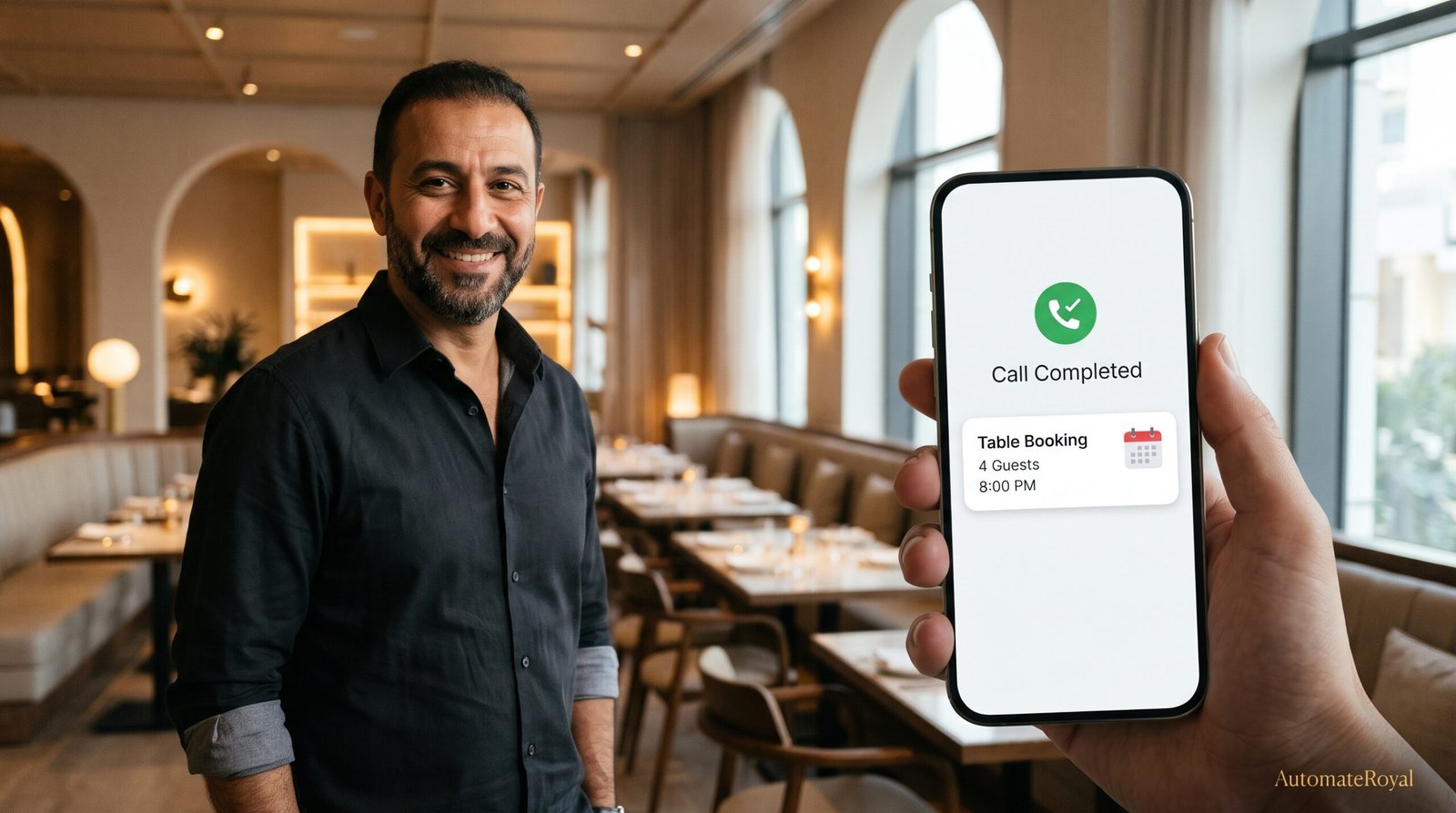
For most small and mid-sized businesses, the best answer is a mix: an AI calling agent answers the routine calls, day and night, and a human takes the calls that need judgment, care or a decision. A full human call centre makes sense when call volumes are very high and most calls are complex. An AI calling agent alone makes sense when most calls are simple and repeat, such as opening hours, bookings and basic questions.
An AI calling agent is software that answers a phone call, talks with the caller in natural speech, understands what they want, and does the task: answer a question, book an appointment, take a message, or transfer the call. A human call centre is a team of people, in your office or at an outsourcing company, doing the same job.
In this guide we compare the two honestly, explain what the rules say about calls, what each costs in terms of what drives the price, and where AI calling goes wrong. If you want an AI calling agent set up for your business, you can reach us at AutomateRoyal or by email at automateroyal@gmail.com.
What an AI Calling Agent Does
When a call comes in, the agent works through a short flow.
- It answers on the first ring, at any hour, and says who it is. Callers should know they are speaking to an automated assistant.
- It listens and works out what the caller wants, in plain speech, in the languages you set up, for example English and Arabic.
- It answers questions from your own approved information: opening hours, prices you have approved, directions, policies.
- It does the task. It can take a booking, collect an enquiry, or take a message, and write the details into your calendar, CRM or a sheet.
- It hands over when needed. If the caller is upset, asks for a person, or asks something outside its information, it transfers the call or books a call back, with a short summary so the caller does not have to repeat themselves.
- It sends a follow-up, such as a confirmation text or an email.
For a deeper look at how voice agents work and what they cost, read our guide to AI voice agents for business.
What a Human Call Centre Does Better
People are better than software in a few clear ways, and a fair comparison should say so.
- Judgment. A person can decide to make an exception, calm an upset caller, or sense that something is wrong.
- Complex and emotional calls. Complaints, bad news, medical worries and negotiations need a human voice.
- Unusual questions. A person copes with a question nobody planned for. An AI agent should admit it does not know and hand over.
- Trust. Some callers, in some situations, simply want a person, and they should always be able to reach one.
Where the AI calling agent does better:
- Availability. It answers every call at any hour, including nights, weekends and holidays, without a rota.
- Peaks. It can take many calls at the same time, so callers are not left waiting.
- Consistency. It gives the same approved answer every time and always follows the call steps.
- Records. Every call can be summarised and logged automatically.
What decides the choice is the mix of your calls. If most calls are repeat questions and bookings, an AI agent covers them well. If most calls are complex, you need people, with AI as a helper.
Examples by Business Type
- Clinics and dental practices: the agent answers after-hours calls, books appointments, and passes urgent cases to the on-call team. It should not give medical advice. See our guide to AI answering for dental calls after hours.
- Hotels and guesthouses: the agent answers room, parking and check-in questions, takes booking enquiries and passes complaints to a manager. For messages as well as calls, see our guide to AI chatbots for hotels.
- Real estate agencies: the agent answers property enquiries, asks a few qualifying questions and books viewings. Read our guide to AI lead qualification for real estate agencies in the Gulf.
- Restaurants: the agent takes table bookings and answers questions about opening hours and menus, so staff are not interrupted during service.
- Trades and local services: the agent takes the job details when the owner is on site, and sends them as a text summary.
The Rules: Calls, Recording and Telling Callers It Is a Bot
Calls involve personal data and sometimes recordings, so rules apply. These are summaries, not legal advice, so please check with a lawyer in your country.
Inbound calls (customers call you). Tell callers they are speaking to an automated assistant, say if the call is recorded and why, collect only what you need, keep recordings secure, and give an easy way to reach a person.
Outbound calls (you call customers). This is where most of the risk is. In the UK, the ICO’s guidance separates live calls, where a person speaks, from automated calls, which play a recording through a dialling system and fall under different PECR rules. The ICO page I opened does not mention AI-generated voices, so whether an AI voice call counts as automated depends on how it is set up and should be checked against the ICO’s Guide to PECR before you launch. Calls that include marketing or promotion need to follow the marketing rules. Read the ICO’s page on live direct marketing calls.
United States. The FCC adopted a Declaratory Ruling treating calls made with AI-generated voices as artificial under the Telephone Consumer Protection Act. See the FCC’s announcement. If you serve US customers, take advice on consent before any outbound AI calls.
Saudi Arabia, Qatar and the UAE. The Saudi PDPL asks for consent for each purpose, an easy opt-out for marketing and limits on sending data abroad. Qatar’s Law 13 of 2016 asks for consent, and prior consent for direct electronic marketing. The UAE’s Federal Decree-Law 45 of 2021 asks for specific consent and restricts transfers abroad.
Our practice. We set up inbound calls first. We disclose that the caller is speaking to an automated assistant, we keep data in your own accounts, and we do not build outbound cold-calling agents without a clear consent basis for each country.
The Hybrid Model: What to Automate and What to Keep Human
Most of our clients choose a hybrid. The AI agent is the front line and your team is the second line.
Automate: opening hours and directions, booking and rescheduling, simple price and service questions, after-hours calls, missed calls, taking messages and enquiries, appointment reminders, and call summaries.
Keep human: complaints, anything involving safety or health decisions, large or unusual orders, negotiations, upset or vulnerable callers, and any caller who asks for a person.
A good setup has three rules. First, a caller can always reach a person quickly. Second, the AI agent never guesses, and hands over when it is unsure. Third, every handover includes a summary, so your team starts the conversation informed. We also suggest reading a sample of call summaries each week, to catch problems early. If you also lose calls because nobody picks up, see our guide to missed call text back.
What Each Option Costs
We do not quote prices in articles, because they change with the tools and the scope, but we can show you what drives the cost.
Human call centre. The cost is mostly people: wages, training, management, breaks and cover for nights and holidays. It rises in step with the hours you want covered and the number of calls at once.
AI calling agent. There is a one-time setup, which depends on how many call types it handles, how many languages, and what it connects to (calendar, CRM, booking system). Then there are monthly running costs for the phone number, the call minutes and the AI and hosting behind it. It rises with the number of call minutes, not with the number of staff.
The fair way to compare is to count your own calls and minutes, including the nights and weekends you currently miss. For the factors that move the price, read our guide on what AI automation costs for a business. For a quote based on your own calls, book a free 20-minute call.
Where AI Calling Goes Wrong
AI calling has improved, but it is not perfect. These are the common problems.
- Accents, noise and bad lines. Speech recognition can misunderstand a caller, especially with background noise or a strong accent. We test with your real callers’ speech and set the agent to ask the caller to confirm key details.
- Wrong answers. If the information is old or incomplete, the answers will be too. Someone must own and update it.
- Pretending to be human. Callers should be told. A bot that hides what it is damages trust.
- No way out. A caller stuck with a bot that does not understand is a lost customer. A person must always be reachable.
- Awkward pauses. There can be a short delay while the agent thinks. We tune the setup to keep it small, but it is not zero.
- Outbound calling risk. Calling people who have not agreed to be called can break the law and harm your name.
- Platform changes. Phone, speech and AI providers change their prices and rules, so the setup needs an occasional check.
How We Set This Up for You
- Free 20-minute call. We learn what calls you get, when you miss them, and what callers ask.
- Plan. We agree what the agent answers, what it hands over, the languages, and the rules for recordings and data.
- Build. We set it up in your own accounts, so you own it and can see everything it does.
- Test. We call it ourselves with the questions and accents your callers use, and check every answer and handover.
- Handover. We show your team the call summaries and how to update the information, and stay available if you need changes.
What you get: an AI calling agent answering your inbound calls, bookings and messages written to your calendar or CRM, a call summary for each call, handover to your team when needed, and a simple report.
Frequently Asked Questions
Will it replace my staff? Usually not. It takes the routine calls, so your team can focus on the calls that need a person.
Will callers know it is an AI? Yes. We set it to say so at the start of the call, and a person is always reachable.
Does it speak Arabic and English? It can, and we test each language before launch.
Can it make outbound sales calls? We do not build cold-calling agents without a clear consent basis, because the rules differ by country and can be strict.
What if it does not understand the caller? It asks the caller to repeat or confirm, and if that fails, it hands over to a person or books a call back.
Is it cheaper than a call centre? It depends on your call volume and the hours you need covered. We help you count your own calls first.
Book a free 20-minute call through AutomateRoyal or email us at automateroyal@gmail.com.